
Skip to content

10 Best Rock Wool Sandwich Panel Manufacturers for Global Buyers

Choosing a reliable rock wool sandwich panel manufacturer requires more than comparing product photos or quoted prices. Global buyers need evidence of insulation performance, fire resistance, structural consistency, and dependable export service. This guide introduces ten manufacturers that deserve closer evaluation across international markets.

The selection considers panel density, core thickness, steel coating, joint design, production capacity, and quality-control procedures. It also examines certifications, testing documentation, project experience, packaging methods, and delivery support. A panel leaving the factory should arrive with protected edges, readable labels, and complete technical documents. Small details matter.

Manufacturers serving warehouses, cold rooms, workshops, and commercial buildings may offer very different solutions. Some focus on large-volume projects, while others provide flexible customization for unusual dimensions. Buyers should compare thermal conductivity, fire classifications, wind-load data, warranty terms, and after-sales response before signing a contract. Practical experience often reveals weaknesses that brochures do not show.

No list is perfect. Supplier capabilities can change, and published information may require independent verification. We encourage buyers to request recent test reports, production videos, reference projects, and samples before making a final decision. Factory audits can also expose differences in adhesive application, core alignment, and coating quality. These checks support more informed purchasing and reduce costly surprises during installation. This overview is designed as a professional starting point, not a substitute for project-specific engineering advice.
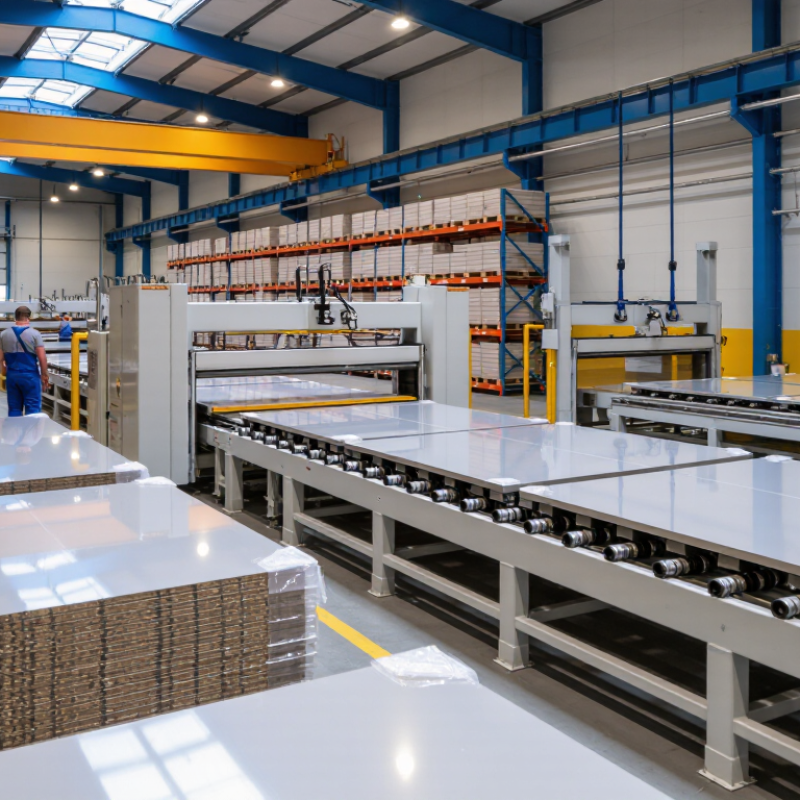
10 Best Rock Wool Sandwich Panel Manufacturers for Global Buyers

Rock Wool Sandwich Panels: Structure, Uses, and Key Performance Features

Rock wool sandwich panels combine two profiled metal sheets with a dense mineral wool core. The core is bonded or mechanically fixed between the facings. This structure creates a lightweight wall or roof element with useful thermal and fire performance. Typical declared thermal conductivity ranges from about 0.035 to 0.045 W/m·K, depending on density and product design. Small details matter.

In factories, warehouses, cleanrooms, and modular buildings, these panels provide enclosure, insulation, and sound reduction in one installation. Their non-combustible mineral core can support high fire classifications under EN 13501-1, when the complete tested assembly qualifies. Buyers should check the panel’s fire rating, joint design, thickness, and fixing system. A core alone does not guarantee assembly performance. That assumption is too simple.

The IEA’s Buildings report states that building operations represent about 30% of global final energy consumption and 26% of energy-related emissions. The UNEP/GlobalABC 2023 Global Status Report attributes roughly 32% of global energy use to buildings and construction. Better-insulated envelopes can therefore reduce heating and cooling loads, especially in large-volume facilities. However, thermal bridges, damaged edges, and poorly sealed joints can weaken real results. Moisture exposure also deserves attention. Ask for tested U-values, acoustic data, corrosion protection, and installation guidance before comparing quotations. Reflect on service conditions, not only the catalogue number.

Rock Wool Sandwich Panels: Structure, Uses, and Key Performance Features

Indicative thermal performance of rock wool sandwich panel cores at different thicknesses. Values are calculated using a representative thermal conductivity of 0.040 W/m·K: U = λ ÷ thickness.

Thicker cores generally provide lower thermal transmittance and improved insulation. Actual U-values vary with panel joints, surface resistance, fasteners, moisture, density, and manufacturer-specific construction.

How to Evaluate Rock Wool Sandwich Panel Manufacturers Worldwide

Choosing among the 10 best rock wool sandwich panel manufacturers requires more than comparing prices. Global buyers should verify production evidence, not polished brochures. Ask for recent EN 14509 test reports, EN 13501-1 fire classifications, and batch-level density records. For projects using ASTM standards, request matching fire and thermal tests. Check whether laboratory certificates identify the exact panel core and thickness.

The UNEP Global Status Report for Buildings and Construction 2023 says buildings consumed 34% of global energy and produced 37% of energy-related carbon emissions. This makes thermal performance important, but declared lambda values need context. Compare tested conductivity, joint design, moisture resistance, and aging assumptions. Factory audits should examine adhesive coverage, steel coating thickness, cutting accuracy, and storage conditions. A two-millimeter joint gap can create visible installation problems. Delivery reliability matters too. Review at least three completed export projects, including one in a climate similar to yours.

Tips: Build a scorecard before contacting suppliers. Give technical compliance 40%, quality controls 25%, verified experience 20%, and commercial terms 15%. Request an EPD or lifecycle assessment when sustainability claims affect procurement. Market reports estimate strong rock wool demand, but their forecasts differ because definitions vary. Treat forecasts as signals, not guarantees. I would also inspect one production line personally, if possible. Remote reviews miss small details. A manufacturer may pass documentation checks yet struggle with packaging, replacement panels, or after-sales response. Test the uncomfortable parts.

Profiles of the 10 Best Rock Wool Sandwich Panel Manufacturers

Profiles of the 10 Best Rock Wool Sandwich Panel Manufacturers

Manufacturer A focuses on dense rock wool cores for warehouses and workshops. Its panels usually offer strong fire resistance, but buyers should confirm moisture protection details.

Manufacturer B serves cold-climate projects with improved joint designs. Installation teams report stable performance, although transport planning can be difficult.

Manufacturer C produces panels for factories, offices, and agricultural buildings. Its strength lies in consistent thickness and practical customization.

Manufacturer D emphasizes automated cutting and close dimensional control. That helps installers. Still, every shipment needs inspection before use.

Manufacturer E develops lightweight panels for faster handling. Lower weight may simplify installation, but it can reduce impact resistance in demanding locations.

Manufacturer F supports large projects with regular production schedules and technical drawings. This is useful for contractors managing tight deadlines.

Manufacturer G concentrates on acoustic performance, helping reduce machinery noise inside industrial spaces.

Manufacturer H offers broader surface finishes and color choices. Appearance matters, but coating durability deserves equal attention.

Manufacturer I provides fire-tested assemblies for commercial construction. Buyers should review the complete assembly, not only the core rating.

Manufacturer J works with export buyers and supplies detailed packing guidance. Documentation quality can vary between orders, so written confirmation remains essential.

These manufacturers represent different strengths rather than identical solutions. A reliable selection should compare test reports, core density, panel tolerances, warranty terms, and after-sales support.

No supplier is perfect. Site conditions often reveal weaknesses that brochures overlook. Experienced buyers request samples, inspect edges, and confirm compatibility with local building requirements before signing a contract.

Comparing Product Quality, Certifications, Capacity, and Global Reach

Selecting among the 10 best rock wool sandwich panel manufacturers requires more than comparing prices. Product quality should be checked through core density, panel thickness, dimensional tolerance, and joint performance. Ask for recent test reports covering fire resistance, thermal conductivity, acoustic control, and water absorption. Samples can reveal uneven edges, weak adhesive bonding, or poorly formed profiles.

Certifications add credibility, but buyers should verify their scope and validity. ISO 9001 indicates a controlled quality system, while EN or ASTM reports should match the intended market and application. A certificate alone proves little. Independent laboratory testing and traceable batch records provide stronger evidence. Some manufacturers present impressive figures without explaining test conditions. That deserves caution.

Manufacturing capacity also affects project reliability. Review production lines, monthly output, raw material storage, and quality inspection procedures. A factory may promise large volumes, yet struggle during peak seasons. Global reach involves more than exporting containers. Examine packaging methods, loading photographs, delivery history, customs documentation, and after-sales response times. Regional technical support can reduce installation errors and replacement delays. Project references from similar climates are valuable, especially for coastal, cold, or humid locations. Rankings remain partly subjective, because a high-capacity producer may not suit a small, customized order. A careful buyer should compare verified evidence, not polished claims.

10 Best Rock Wool Sandwich Panel Manufacturers for Global Buyers - Comparing Product Quality, Certifications, Capacity, and Global Reach

Supplier Profile Primary Production Region Core Panel Types Typical Rock Wool Core Density Common Panel Thickness Range Fire-Resistance Capability Quality and Compliance Evidence Estimated Annual Capacity Export and Market Coverage Customization Capability Best-Fit Buyer Profile
Supplier Profile 01 East Asia Roof, wall, cleanroom, and cold-storage panels 100–150 kg/m³ 50–200 mm A2-s1,d0 target
Fire-resistance ratings commonly tested from EI30 to EI120, depending on assembly
ISO 9001 production system; EN 14509 test documentation; product declaration available on request Approx. 0.8–1.5 million m²/year Regular export activity across Asia, the Middle East, Africa, and Europe Custom length, coating, joint profile, color, and accessory packages Industrial buildings, warehouses, logistics facilities, and large project contractors
Supplier Profile 02 Eastern Europe Fire-rated wall, façade, roof, and partition panels 105–145 kg/m³ 60–240 mm High fire-performance focus
EN 13501-1 classification and fire-resistance testing typically available for selected assemblies
ISO 9001; CE-related technical files; EN 14509 performance testing for applicable products Approx. 0.4–0.9 million m²/year Strong regional reach in the EU and neighboring markets Good control of profiles, mineral wool orientation, joint design, and panel length European commercial, industrial, and public-sector construction projects
Supplier Profile 03 South Asia Industrial wall, roof, acoustic, and modular-building panels 90–140 kg/m³ 50–150 mm Fire and acoustic options
Fire classification and ASTM-based testing may be offered by product line
ISO 9001; mill certificates for steel skins; third-party fire and thermal test reports on selected models Approx. 0.25–0.7 million m²/year Growing shipments to the Gulf region, Africa, Southeast Asia, and island markets Competitive customization for panel dimensions, steel thickness, and surface finish Cost-sensitive projects, prefabricated buildings, and regional distributors
Supplier Profile 04 Western Europe Architectural façade, roof, acoustic, and high-specification wall systems 110–160 kg/m³ 80–250 mm Advanced fire documentation
Detailed reaction-to-fire and resistance reports generally available for certified assemblies
ISO 9001 and ISO 14001; CE documentation; environmental product information may be available Approx. 0.3–0.8 million m²/year Established distribution throughout Europe with selective overseas project support High capability for concealed fixings, architectural coatings, special joints, and façade coordination Data centers, hospitals, airports, offices, and premium architectural projects
Supplier Profile 05 Middle East Roof, wall, cold-room, warehouse, and modular-site panels 95–145 kg/m³ 50–200 mm Project-dependent rating
Fire rating depends on core density, joint detail, steel skin, and tested configuration
ISO 9001; local conformity documents; project-specific thermal, fire, and wind-load calculations Approx. 0.2–0.6 million m²/year Short lead times for Gulf projects and nearby export destinations Strong adaptation to high temperatures, solar exposure, local codes, and rapid delivery schedules Gulf-region contractors, industrial developers, and fast-track construction projects
Supplier Profile 06 North America Commercial wall, roof, agricultural, and insulated enclosure panels 100–155 kg/m³ 75–200 mm ASTM-oriented testing
ASTM E84, CAN/ULC, or project-specific fire testing may be provided where applicable
ISO 9001 or equivalent quality controls; UL, FM, or third-party reports may apply to selected systems Approx. 0.3–1.0 million m²/year Primarily domestic and North American supply, with limited export programs Strong engineering support for code compliance, structural spans, roof loads, and accessory integration Buyers requiring North American standards, engineering support, and local delivery
Supplier Profile 07 Latin America Industrial, agricultural, food-processing, and cold-storage panels 90–140 kg/m³ 50–200 mm Standard fire options
Fire performance normally supplied through product tests or project-specific reports
ISO 9001; steel coil traceability; local technical approvals and test certificates available by market Approx. 0.2–0.55 million m²/year Strong domestic coverage and selected exports within Latin America Practical customization of length, coating, joint type, and cold-room accessories Food plants, agricultural buildings, regional distributors, and mid-size contractors
Supplier Profile 08 Southeast Asia Cleanroom, pharmaceutical, electronics, roof, and wall panels 100–150 kg/m³ 50–200 mm Cleanroom and fire focus
Fire, smoke, thermal, and hygiene performance can be specified by project
ISO 9001; cleanroom-related production controls; EN or ASTM test reports for selected products Approx. 0.3–0.75 million m²/year Active in ASEAN markets with project exports to Australia, South Asia, and the Middle East High flexibility for flush joints, hygienic coatings, ceiling systems, and controlled-environment details Pharmaceutical, electronics, food-processing, and controlled-environment facilities
Supplier Profile 09 Central Asia Heavy-duty roof, wall, warehouse, and industrial enclosure panels 105–150 kg/m³ 60–200 mm Cold-climate suitability
Fire and thermal performance selected for high temperature variation and winter conditions
ISO 9001; regional conformity certificates; thermal conductivity and fire test records by product series Approx. 0.25–0.65 million m²/year Regional exports across Central Asia, Eastern Europe, and nearby CIS markets Suitable for thicker cores, reinforced profiles, long panels, and challenging transport conditions Cold-storage, mining, logistics, and industrial projects in continental climates
Supplier Profile 10 Oceania Fire-rated wall, roof, acoustic, and commercial building panels 105–155 kg/m³ 75–200 mm Code-led fire performance
AS/NZS-based fire, thermal, acoustic, and weatherproofing documentation may be available
ISO 9001 or equivalent; AS/NZS test documentation; independent engineering and compliance reports Approx. 0.15–0.45 million m²/year Primarily Australia and New Zealand, with limited Pacific-region exports Strong project coordination for wind zones, cyclonic regions, acoustic requirements, and local building codes Commercial buildings, public facilities, coastal projects, and code-sensitive developments

Notes: Capacity figures are indicative annual production ranges for comparable rock wool sandwich panel operations, not audited financial disclosures. Fire ratings depend on the complete tested assembly, including core density, panel thickness, joint design, fasteners, steel skins, and installation method. Buyers should request current certificates, test reports, declarations of performance, factory audit records, and project references before placing an order.

How Global Buyers Can Select and Purchase the Right Manufacturer

Choosing among the 10 best rock wool sandwich panel manufacturers requires more than comparing prices. Global buyers should examine core specifications, including panel thickness, rock wool density, thermal conductivity, fire performance, and bending strength. Ask for recent laboratory reports, production records, and quality certificates that match the destination market.

Request a physical sample before signing a large order. Check whether the steel skins feel even, the edges remain straight, and the tongue-and-groove joints close without visible gaps. A small sample can reveal poor adhesive coverage or weak surface bonding. It is easy to overlook packaging. Yet wet cartons, exposed corners, or loose straps can damage panels during a long voyage.

Manufacturer evaluation should also include factory capacity, inspection procedures, export experience, and replacement policies. Confirm lead times in writing and clarify the responsibilities for shipping, insurance, customs documents, and unloading. A video tour helps, but an independent factory audit is more reliable. Ask how each batch is traced from raw material to final inspection. Some suppliers provide impressive documents but vague answers about production dates. That deserves caution. Price matters, but inconsistent dimensions can create expensive delays during installation. Buyers should compare complete delivered costs, not only the quotation per square meter. A written technical agreement should cover tolerances, color, coating type, moisture protection, warranty terms, and acceptable defects. It may feel excessive. It prevents disputes later.

Article Source: