
Skip to content

Top 10 Food Bucket Types for Global Buyers

Choosing the right food bucket is more complex than comparing colors, capacities, and unit prices. Global buyers must examine material safety, wall strength, closure design, and supply consistency. A bucket may look durable, yet its handle can fail during warehouse movement. Small details matter.

This guide introduces ten food bucket types for different commercial and household needs. It considers plastic grades, stackable shapes, airtight lids, metal options, and reusable formats. Each type offers practical advantages, but none solves every storage challenge. Temperature, moisture, filling equipment, transport distance, and cleaning routines can change the best choice.

From hands-on purchasing experience, reliable evaluation starts with clear specifications. Buyers should request food-contact documentation, production samples, load tests, and traceability records. They should also confirm whether the supplier can maintain the same dimensions across repeated orders. Consistency protects filling lines and reduces avoidable waste.

Think beyond the first shipment.

A strong food bucket should protect contents, support safe handling, and fit the buyer’s operating environment. Regional requirements may differ, so professional compliance checks remain essential. Supplier audits and independent testing can provide stronger evidence than marketing claims.

This overview is practical, not absolute. Some recommendations may need revision after real-world testing. A lightweight bucket can reduce freight costs, but it may feel less secure when filled. A rigid design can improve stacking, yet increase transport weight. Careful buyers compare these trade-offs before committing to large volumes.
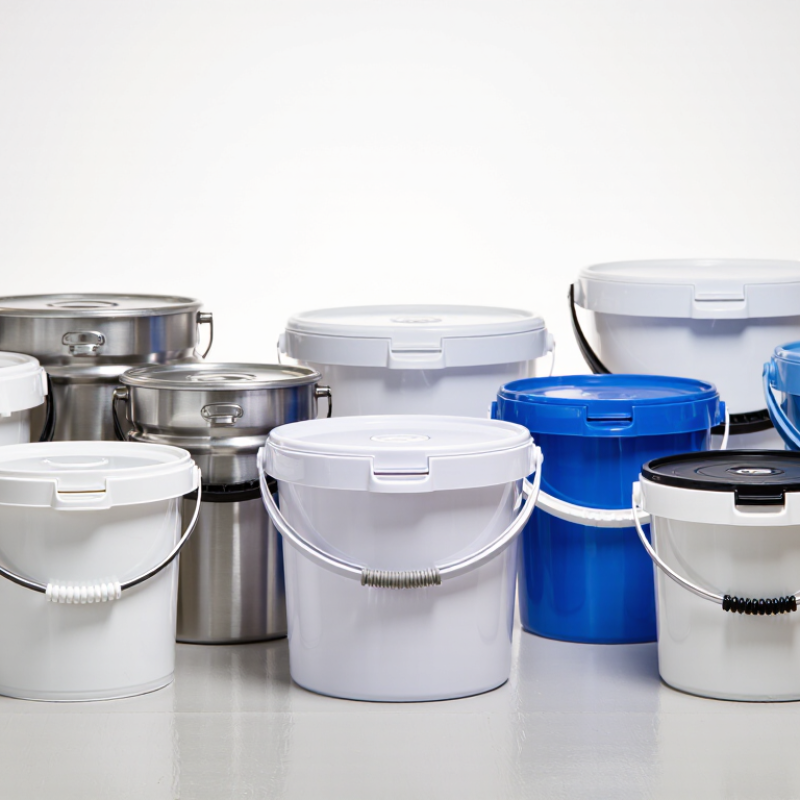
Top 10 Food Bucket Types for Global Buyers

Food Bucket Basics: Materials, Sizes, and Common Applications

Top 10 Food Bucket Types for Global Buyers

Food buckets differ by material, size, lid design, and handling needs. The ten practical types include HDPE round buckets, PP buckets, square buckets, stackable buckets, nesting buckets, tamper-evident buckets, wide-mouth buckets, screw-top buckets, metal-lined buckets, and small portion buckets. HDPE suits sauces, grains, powders, and pickled foods because it resists impact and moisture. PP handles warmer filling better, but buyers must confirm the approved temperature range. Metal-lined designs support products requiring stronger barrier protection. They cost more and need careful inspection for coating damage.

Capacity & Handling Common capacities range from 1 to 25 liters.

Small buckets suit spices, toppings, and foodservice portions. Medium sizes fit syrups, sauces, and dry ingredients. Larger buckets serve bakeries, processors, and bulk distribution. Round bodies stack reliably, while square bodies use warehouse space more efficiently. A tight lid matters. So does the seal.

The FAO’s 2019 report estimated that 14% of food is lost between harvest and retail. Packaging cannot solve every loss, but a secure bucket can reduce leakage, moisture entry, and handling damage. The UNEP Food Waste Index Report 2024 recorded 1.05 billion tonnes of food waste in 2022. That makes sizing and protection practical concerns, not decoration. Yet I would not select a bucket from dimensions alone. OECD’s Global Plastics Outlook projects plastic waste could nearly triple by 2060. Reusable systems may help, although cleaning, transport distance, and return rates can weaken the benefit. Food-contact documentation, migration testing, closure performance, and traceability should guide the final purchase. Some specifications still look perfect on paper. Real warehouse trials may disagree.

How the Top 10 Food Bucket Types Are Classified

For global buyers, the top 10 food bucket types are best classified by material, structure, closure, and intended use. This method is more practical than judging appearance alone. Food-grade plastic buckets may use different resin types, while metal buckets serve products requiring stronger impact resistance. Size matters. Common capacities range from small household packs to large commercial containers.

A second classification separates round, square, stackable, nesting, and tapered buckets. Round buckets are easy to handle and clean. Square designs use warehouse space efficiently. Tapered buckets nest together during transport, reducing empty-volume costs. Stackable models need stable rims and reinforced bases. These details affect loading safety, shelf storage, and manual handling.

Closure systems create another important group. Snap-on lids suit frequent access, while airtight seals help protect dry foods from moisture and odors. Tamper-evident lids provide visible opening evidence during distribution. Some buckets also include handles, pouring lips, or measuring marks for foodservice use. Buyers should verify food-contact declarations, migration test results, traceability records, and local packaging requirements before ordering. A bucket can look suitable but still fail testing. Not every lid fits. In practice, classification is not perfect, because one bucket may belong to several types at once. A stackable bucket can also be airtight and tamper-evident. This overlap should be recorded clearly in technical specifications, not hidden in sales descriptions.

Comparing Bucket Types by Safety, Durability, and Cost

Food buckets look simple, but their design affects safety, durability, and landed cost.

Global buyers commonly compare food-grade HDPE, food-grade PP, round pails, square buckets, and stackable buckets. Other options include nesting, snap-lid, screw-top, tamper-evident, and insulated buckets.

Not every bucket fits. Material alone does not prove food suitability. Request food-contact documents, migration test results, odor checks, and batch traceability.

A smooth interior reduces residue buildup and supports practical cleaning. PP often tolerates warmer filling, while HDPE usually provides strong impact resistance. Always confirm the supplier’s temperature range.

Round buckets resist denting and suit automated handling, while square designs use warehouse space more efficiently. Stackable models can reduce freight volume, although unstable lids may cause transport damage.

Snap lids are economical and quick to open. Screw tops provide tighter protection, but increase cost and packing time. Tamper-evident features improve distribution confidence, not food quality itself.

Insulated buckets support temperature-sensitive products, yet their extra material raises purchase and disposal costs. Check the lid seal.

In purchasing reviews, the cheapest unit often becomes expensive after cracked handles, leaking lids, or poor pallet use. Premium construction is not automatically better. Some buyers over-specify thickness and pay for unused strength.

Compare total cost per delivered unit, including testing, tooling, freight, storage, and rejected batches.

Requirements vary by country, product acidity, filling temperature, and recycling access. Real shipments sometimes expose assumptions that laboratory samples never reveal.

Global Buyer Requirements: Regulations, Labeling, and Logistics

Top 10 Food Bucket Types for Global Buyers

Global buyers should evaluate food buckets beyond shape and price. Common options include PP pails, HDPE buckets, airtight buckets, tamper-evident buckets, stackable buckets, nestable buckets, metal-handle buckets, square buckets, IML-labeled buckets, and recycled-content buckets. Each type suits different products, warehouse systems, and transport routes. OECD’s Global Plastics Outlook (2022) reports that packaging creates about 40% of global plastic waste. Material efficiency matters. A thinner wall can reduce waste, but it may weaken under heat or stacking pressure.

Food-contact compliance must match the destination market. Buyers should request migration tests, material declarations, batch traceability, and supplier quality records. Codex Standard CXS 1-1985 provides internationally recognized principles for labeling prepackaged foods. Labels may need product identity, net quantity, ingredients, allergens, origin, lot number, and storage conditions. Requirements still differ between countries. Do not assume one label works everywhere. Recycled plastic also needs separate verification for food contact use.

Logistics can quietly damage a good packaging decision. UNCTAD’s Review of Maritime Transport 2023 states that shipping carries over 80% of world trade by volume. Buckets may face vibration, salt air, humidity, and temperature changes for weeks. A bucket can pass a factory test and still fail at a humid port. I would test filled pallets, not empty samples. EU Regulation 2025/40 generally applies from August 2026 and increases packaging sustainability obligations. Compliance planning should begin before production, although smaller suppliers may still overlook documentation.

Buyer guidance: These are ten commonly specified nominal capacities for food-grade pails used for sauces, dairy products, powders, pickles, oils, and other bulk foods. PP and HDPE are widely used polymers, but the final material, lid system, liner, colorant, and barrier properties must be verified for the intended food contact and temperature conditions.
Global requirements: Buyers should confirm food-contact compliance for the destination market, including applicable EU food-contact rules such as Regulation (EC) No 1935/2004 and GMP Regulation (EC) No 2023/2006, or relevant U.S. FDA requirements such as 21 CFR 177.1520 for applicable olefin polymers. Labels commonly need product identity, net quantity, ingredients, allergens, lot or batch code, date information, storage conditions, and importer details. Smaller buckets generally improve handling, while larger buckets can reduce packaging units and handling cost but require stronger closures and pallet planning.
Note: Capacities are nominal industry formats rather than a sales ranking; actual availability, dimensions, tare weight, and pallet utilization vary by supplier and market.

How to Select the Right Food Bucket for Each Market

Choosing among the top 10 food bucket types starts with the market, not the catalogue.

Tropical markets need moisture-resistant HDPE buckets with tight lids and strong handles. Dry-food markets may prefer stackable square buckets, which reduce warehouse space.

Cold-chain markets require plastics that remain impact-resistant at low temperatures. For powdered products, airtight buckets with reliable seals help prevent clumping and contamination.

The FAO’s State of Food and Agriculture report estimates that 14% of food is lost between harvest and retail. Packaging cannot solve every loss, but it can reduce exposure, leakage, and handling damage.

The UNEP Food Waste Index Report 2024 reported 1.05 billion tonnes of food waste in 2022. That figure makes bucket durability more than a purchasing detail. Reusable, food-contact-grade PP or HDPE can support repeated handling, but recycled content must be verified for the intended application.

Local requirements differ. A bucket accepted in one market may fail another market’s food-contact review.

Tips:

Match the bucket to the food’s moisture, acidity, weight, and filling temperature. Test the lid after transport, not only in the warehouse. Check stacking stability with a real load. For exports, confirm pallet dimensions and climate exposure.

A tamper-evident lid may improve trust, while a vented design can protect warm products from pressure buildup. Do not assume “food grade” means globally compliant.

Ask for migration tests and batch documentation. The cheapest bucket can become the costliest mistake.

I still see buyers underestimating handle strength. That detail deserves another review.