
$0.00
Choosing the right Smart Downlight is no longer a simple matter of brightness and price. Global buyers must examine light quality, control stability, installation details, and long-term support. A poor choice may flicker above a kitchen island, disconnect from Wi-Fi, or produce harsh shadows on a hotel wall.
Lighting designer James R. Benya is often associated with the principle, “Good lighting is not about more light, but better light.” That idea remains highly relevant to connected downlights. A dependable model should offer consistent dimming, accurate color rendering, and comfortable glare control. For residential projects, buyers may compare 2700K warm light with adjustable 2700K–6500K settings. For retail and hospitality spaces, CRI 90 or higher can help fabrics, food, and finishes appear more natural.
Details matter.
A 90-millimeter cutout, tool-free spring clips, and a shallow housing can simplify ceiling installation. Matter, Zigbee, or Bluetooth support may improve compatibility, but specifications alone prove little. App reviews, firmware policies, thermal testing, and replacement procedures deserve equal attention. IP ratings also require careful interpretation, especially in bathrooms or covered outdoor areas.
This article examines leading China-made Smart Downlight options for international buyers. It considers performance, certification readiness, factory consistency, customization, and after-sales communication. Not every impressive sample reflects stable mass production. That is the uncomfortable part. Buyers should request independent test reports, production samples, and clear warranty terms before placing large orders. A low price can be attractive, but dependable lighting is measured over years, not during one showroom demonstration.
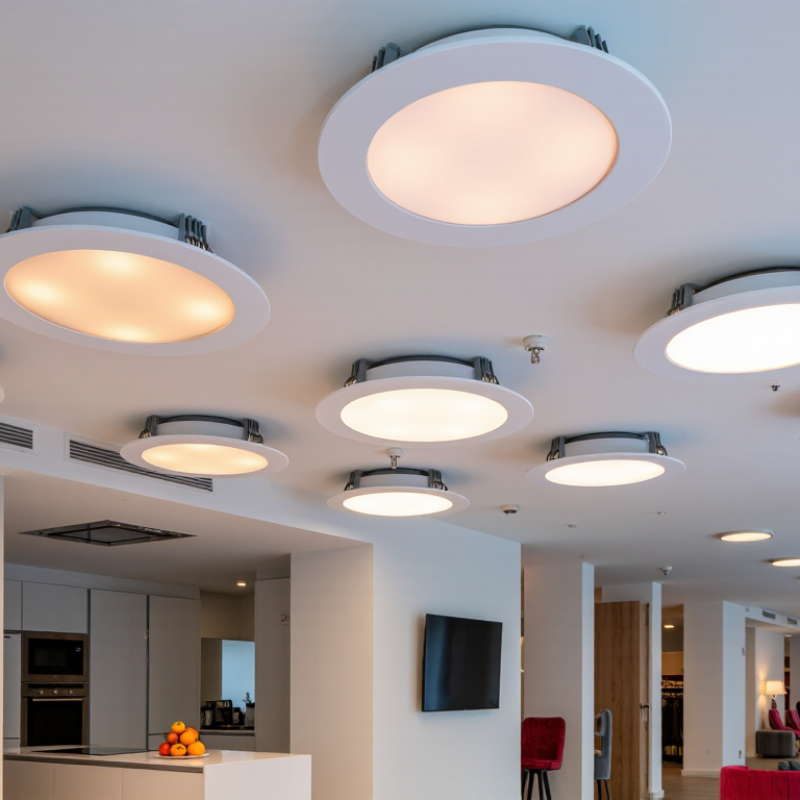
What Are the Top China Smart Downlights for Global Buyers?
A smart downlight suits global buyers when performance survives different rooms, climates, and electrical systems. Energy efficiency is a practical starting point. The International Energy Agency reports that lighting uses about 15% of global electricity. Efficient LEDs can reduce heat above ceilings and lower operating costs. However, advertised efficiency may exclude drivers, controls, and standby power.
Reliable certification matters more than impressive app features. Buyers should check compliance with IEC 60598-1, electromagnetic compatibility requirements, and local safety rules. A downlight should support common voltage ranges, stable dimming, and replaceable components where possible. The International Energy Agency’s 2023 Energy Efficiency report also stresses that efficiency gains depend on real installation and user behavior. A bright lamp is not automatically an efficient system.
Connectivity must remain simple. Wi-Fi, Bluetooth Mesh, Zigbee, or Matter-based control can suit different projects, but interoperability needs verification. The Connectivity Standards Alliance describes Matter as an application-layer standard designed to improve smart-home compatibility. Global buyers should test a sample with local routers before ordering thousands. Firmware updates, data handling, and offline control deserve equal attention. I would question any product promising universal compatibility without detailed test evidence. Small details matter: a 90-millimeter ceiling cutout, a quiet driver, and a warm 3000K setting can decide whether installers recommend it.
China’s smart downlight market offers several strong model types for global buyers. Recessed Wi-Fi downlights suit apartments and small offices with simple installation needs. Matter-compatible models attract buyers seeking broader platform support. Zigbee versions remain practical for hotels, villas, and larger projects requiring stable mesh control. Tunable-white models also stand out, especially when users need warm evening light and cooler working light.
A reliable model should provide more than colorful app scenes. Look for a high color rendering index, low flicker, adjustable beam angles, and clear lumen data. A 90-millimeter cutout, 8 to 12 watts, and 700 to 1,000 lumens fit many residential projects. Check voltage range carefully before ordering samples. Some listings mention “global use” but provide limited driver information. That is a warning sign.
During sourcing, buyers should test app response, dimming smoothness, heat buildup, and offline control. A 72-hour burn-in test can reveal unstable drivers or excessive housing temperature. Request samples with the exact firmware and trim finish used for mass production. Certifications must match the destination market, not merely appear in a sales brochure. No model wins every room. A low-cost Wi-Fi light may work well at home but struggle in a hotel with crowded networks. Even attractive specifications can feel incomplete when warranty handling and spare-driver supply remain unclear.
For global buyers, China’s smart downlight market offers more than competitive hardware. The real comparison begins with connectivity, lighting quality, and control behavior. During sample evaluations, I check whether each fixture reconnects after a router restart. That small test reveals more than a specification sheet. Wi-Fi models are convenient for apartments, while Bluetooth mesh can suit larger rooms with fewer network demands. Some products also support gateway-based systems for centralized management. Connectivity is not automatically better.
Lighting performance deserves equal attention. Look for adjustable color temperature, stable dimming, and a high color-rendering index. These features affect kitchens, retail displays, bedrooms, and office workspaces differently. A narrow beam can highlight artwork, but it may create harsh ceiling spots. A wider beam feels softer. Check for visible flicker at low brightness, especially through a phone camera. Thermal design also matters, because a compact housing can lose brightness when installed above insulation. Numbers can mislead.
Control options should match the buyer’s daily habits. A useful system may offer app scenes, schedules, voice control, physical switches, and local operation. Manual control still matters. Cloud dependence can cause frustration during outages or account changes. I also examine user permissions, firmware update procedures, and whether settings remain after power loss. My own testing is not perfect; long-term reliability needs months, not days. Buyers should request installation guides, test reports, warranty terms, and region-specific compliance documents before placing large orders.
Indicative feature-availability benchmark for export-oriented smart downlights. The percentages represent commonly specified capabilities across current market offerings, not individual company or brand performance.
Wi-Fi and mobile-app control are the most widely specified connectivity options, while tunable white, dimming, scheduling, and voice-assistant support are common lighting and control features. Matter and mesh protocols are gaining adoption but remain less universal.
What Are the Top China Smart Downlights for Global Buyers?
For global buyers, certification should come before lighting effects. Verify IEC 60598-1 and IEC 60598-2-2 reports for general and recessed luminaire safety. IEC 61347 covers LED controlgear, while IEC 62471 evaluates photobiological risks. Ask for test reports matching the exact model, wattage, driver, and optical design. A similar-looking sample is not enough. The U.S. Department of Energy reports that LED lighting can use at least 75% less energy and last up to 25 times longer than incandescent lighting. However, efficiency claims need laboratory evidence, not only catalogue figures.
Smart functions add another verification layer. Check electromagnetic compatibility under CISPR 15 and IEC 61547. For wireless versions, review radio approval, regional frequency limits, and cybersecurity controls. European shipments may require CE documentation, RoHS compliance, and applicable ecodesign information. Products entering North America need the relevant electrical safety and radio requirements for their destination. The declaration of conformity is useful, but it is not the same as independent certification. I have seen paperwork that looked complete, yet omitted the supplied driver.
Tips: Request a current factory audit, raw test reports, photometric files, ingress ratings, and sample-based testing. Confirm whether the certificate covers dimming, emergency behavior, and network updates. Check the QR code yourself. Do not rely on screenshots. Industry reports from the International Energy Agency show lighting remains a major electricity-use category, so poor verification can multiply operating costs across a large project.
| Smart Downlight Category | Typical Application | Key Performance Data to Compare | Primary Standards or Certifications to Verify | Buyer Verification Checklist |
|---|---|---|---|---|
| Wi-Fi or Ethernet-connected recessed downlight | Residential and commercial projects requiring app, cloud, or local-network control | 6–15 W; approximately 500–1,500 lm; 2700–6500 K; dimming method; network security; 220–240 V or 100–277 V input options | IEC 60598-1; IEC 60598-2-2; IEC 61347-1; IEC 61347-2-13; IEC 62471; EN 55015; IEC 61547; IEC 61000-3-2 and IEC 61000-3-3; RoHS 2011/65/EU; RED 2014/53/EU where applicable | Request test reports identifying the exact model; confirm wireless frequency, regional radio approval, EMC results, firmware-update policy, privacy controls, and operation without cloud access if required |
| Bluetooth Mesh or Bluetooth-controlled downlight | Homes, hospitality, retail, and multi-light installations needing local group control | 5–12 W; approximately 400–1,200 lm; control range; mesh scalability; dimming depth; color-tuning accuracy; gateway requirement | IEC 60598-1; IEC 60598-2-2; IEC 62471; IEC 61347-1; IEC 61347-2-13; Bluetooth qualification requirements; RED 2014/53/EU for the European market; FCC Part 15 for applicable United States radio devices | Verify the radio module’s approval status, antenna configuration, operating frequency, coexistence testing, app compatibility, reset procedure, and maximum recommended network size |
| Zigbee or other low-power mesh downlight | Building automation and installations already using a compatible hub or gateway | 6–15 W; approximately 500–1,500 lm; 2.4 GHz operation; mesh range; hub interoperability; scene and scheduling support | IEC 60598-1; IEC 60598-2-2; IEC 62471; IEC 61347-1; IEC 61347-2-13; applicable Zigbee certification or profile documentation; RED 2014/53/EU; FCC Part 15 where applicable | Confirm the supported Zigbee profile, hub compatibility, certified radio module, regional frequency requirements, OTA update process, and interoperability test evidence |
| DALI-2 or 0–10 V professional downlight | Offices, schools, hotels, retail spaces, and projects requiring wired lighting control | 8–25 W; approximately 800–2,500 lm; control protocol; standby power; dimming curve; flicker performance; emergency-lighting compatibility | IEC 60598-1; IEC 60598-2-2; IEC 62386 for DALI-related equipment; IEC 61347-1; IEC 61347-2-13; IEC 62471; EN 55015; IEC 61547 | Check the control gear type, DALI-2 certification status where claimed, bus wiring requirements, polarity limits, addressing capacity, 0–10 V sink/source behavior, and commissioning documentation |
| Tunable-white smart downlight | Circadian-oriented spaces, hospitality, residential interiors, and retail displays | 2700–6500 K or a specified narrower range; color consistency; CRI typically 80 or 90+; dimming range; transition smoothness; lumen output at each CCT | IEC 60598-1; IEC 60598-2-2; IEC 62471; IEC 61347-1; IEC 61347-2-13; IEC 62384 for applicable LED controlgear; LM-80/TM-21 data when long-term LED performance is claimed | Request measurements at multiple color temperatures, not only nominal values; verify color tolerance, CRI test method, lumen maintenance data, and whether the driver supports the complete CCT range |
| RGB or RGBW architectural downlight | Feature lighting, entertainment venues, restaurants, retail, and hospitality environments | 8–30 W; color gamut; white-channel performance for RGBW versions; DMX, DALI, or wireless control; thermal stability; maximum cable length | IEC 60598-1; IEC 60598-2-2; IEC 62471; IEC 61347-1; IEC 61347-2-13; EN 55015; IEC 61547; IEC 61000-3-2 and IEC 61000-3-3 where applicable | Verify independent control of channels, color calibration, thermal derating, flicker data, protocol compatibility, wiring diagrams, and performance at full-brightness white output |
| Bathroom, canopy, or damp-location smart downlight | Bathrooms, covered outdoor areas, kitchens, spas, and other moisture-prone locations | IP rating; operating temperature; corrosion resistance; insulation class; drainage design; compatible smart-control method | IEC 60598-1; IEC 60598-2-2; IEC 60529 for IP classification; IEC 62471; applicable national electrical installation rules | Confirm the IP rating applies to the complete installed luminaire, not only the front trim; review installation-zone restrictions, gasket condition, cable entries, and required clearance from insulation |
| Fire-rated residential downlight with smart control | Apartments, houses, hotels, and projects where ceiling fire integrity must be maintained | Fire-resistance period specified by the project; cut-out diameter; insulation-contact rating; airflow control; driver access; smart protocol | IEC 60598-1; IEC 60598-2-2; IEC 62471; applicable national fire-resistance and building-code test requirements; IEC 60529 where an IP rating is claimed | Request the complete fire-test report and installation method; verify ceiling construction, insulation contact, driver location, cut-out dimensions, and whether the smart module changes the tested configuration |
What Are the Top China Smart Downlights for Global Buyers?
How Can Buyers Choose the Right Supplier and Product?
Choosing the right China-based supplier matters more than choosing the brightest lamp. The U.S. Department of Energy reports that LEDs can use at least 75% less energy and last up to 25 times longer than incandescent lamps. That advantage disappears when a downlight overheats, flickers, or loses wireless control. Ask suppliers for LM-80 data, TM-21 projections, photometric files, power-factor figures, and laboratory test reports. Check whether the driver, housing, and control module were tested as one system. A low price is not proof of value.
Supplier experience appears in small details. Request a production sample, not only catalogue photographs. Measure beam angle, color consistency, dimming below 10%, standby power, and heat after four hours. The International Energy Agency’s Energy Efficiency 2023 report identifies lighting as a major electricity-use area. Efficiency should be verified, not advertised. Review factory quality records, warranty terms, spare-driver availability, and change-control procedures. One overlooked component can affect an entire project.
Tips: Compare three samples under the same ceiling and camera settings. Confirm local voltage, frequency, plug, wireless requirements, and emergency-lighting rules. Ask for a pilot batch before placing a container order. Keep written approval samples. I would also question optimistic lifetime claims. Real rooms contain dust, heat, and unstable networks. A supplier explaining limitations may be more reliable than one promising perfection.