$0.00
Choosing the right Covered Yarn in 2026 starts with the fabric’s job, not a catalogue description. A soft stretch waistband, a fine-gauge sock, and a compression sleeve place different demands on yarn. Ask what the end product must do: recover after repeated extension, feel smooth against skin, resist abrasion, or hold its shape after washing. Small details matter. Even the same nominal yarn count can behave differently with changes in core material, covering ratio, twist, and processing tension.
The 2026 market offers more constructions and supplier claims, but more choice does not guarantee a better result. Compare samples under realistic knitting or weaving conditions. Check denier, elongation, recovery, uniformity, and compatibility with your machine settings. Request test methods and lot-to-lot data, then confirm performance in the finished fabric. A lab result is useful; it is not the whole story. For transparent attribution, the following is an editorially written principle, not a verified quotation: fictional composite textile specialist Maya Chen puts it this way, “Choose the yarn that performs in your fabric, not merely the one that looks right on paper.” This guide examines the decisions behind that choice, from application and fibre pairing to quality checks and supplier questions. Some specifications may still need adjustment after trials. That uncertainty is worth stating plainly.
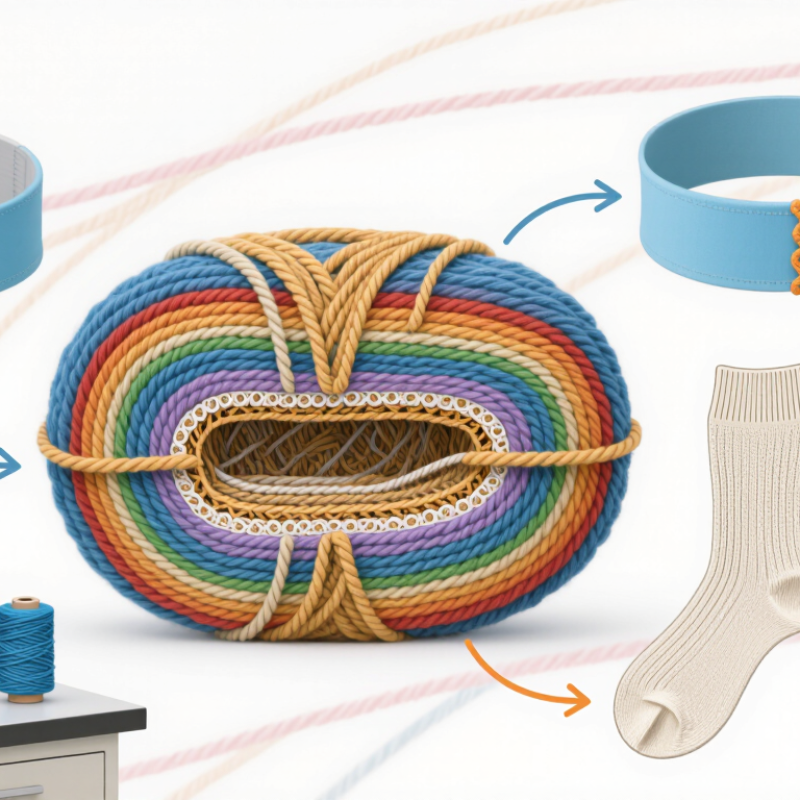
Choosing covered yarn starts with the core, because it largely determines stretch, recovery, and tensile behavior. Elastane is common where fabric must extend and return close to its original shape. A polyester or nylon core may suit applications that prioritize strength or dimensional stability. Check the required extension and recovery, not just the fiber name. Small differences show up after repeated wear.
The cover fiber shapes the surface and performance. Cotton can give a soft, absorbent hand; nylon often feels smooth and resists abrasion; polyester generally dries quickly and holds its dimensions well. Blends can balance these traits, though the result depends on yarn construction and fabric finishing. Then compare covering structure. Single-covered yarn has one wrapping layer and can keep fabric lighter and more economical. Double-covered yarn adds a second wrap, often improving core coverage and reducing slippage, but it may add bulk and cost. Not always better.
Test yarn in the intended fabric. A swatch can reveal roughness, uneven spirals, or core show-through that a specification sheet misses. Measure stretch and recovery, inspect the surface after abrasion, and repeat checks after laundering. Also ask whether the yarn will run smoothly on the planned machine; a technically suitable construction can still cause production trouble. One sample is rarely enough. Compare several lots, and record the conditions, even if the results seem obvious.
Choosing between nylon- and polyester-covered yarn starts with the fabric’s job, not a label. A nylon cover often suits products needing a soft hand, abrasion resistance, and repeated stretch. Polyester can be a strong fit when dimensional stability and lower moisture absorption matter. These are useful tendencies, not guarantees. The core yarn, cover ratio, and finishing process also shape performance. Small changes can matter.
Check stretch and recovery in the finished fabric. Pull a sample to the intended working length, release it, and measure how quickly it returns. Then repeat after washing or exposure to the conditions it will face in use. For socks or close-fitting garments, comfort and recovery may outweigh quick drying. For upholstery or outdoor textiles, dimensional stability and resistance to wear may carry more weight. Ask suppliers for test conditions, not just headline figures.
A yarn that feels excellent on a cone may behave differently after knitting, dyeing, and finishing. Test the actual construction. Compare cover uniformity, fabric growth, pilling, and hand feel across several batches if consistency is critical. I would not choose on fiber type alone; that shortcut is tempting, but incomplete. And sometimes the “best” option changes when the fabric structure changes.
When choosing covered yarn in 2026, compare linear density in the same unit. Denier measures grams per 9,000 metres; dtex measures grams per 10,000 metres. Therefore, 1 denier equals 1.111 dtex. The conversion is exact; the buying decision is not. A 20-denier filament converts to about 22.22 dtex, but that number alone does not describe stretch, coverage, or fabric feel.
ISO 1144 defines the tex system used to express linear density, while ISO 2060 specifies a skein method for measuring yarn linear density. These standards help buyers compare specifications consistently. Still, covered yarn combines components, and suppliers may state the core, covering filament, or total yarn value. Check which one the figure represents. A mismatch can turn a seemingly minor conversion into a real difference on the production floor. Test a sample under your intended knitting or weaving conditions; even a correct label cannot predict every fabric outcome.
Tips: Convert before comparing quotes: dtex = denier × 1.111. For a quick check, 30 denier is about 33.33 dtex. Ask for the measurement basis and test conditions, then verify the yarn on a small run. The arithmetic is simple. The assumptions deserve another look.
For covered yarn, twist is a production setting, not a vague label. State the target in turns per meter (TPM), then add twist direction, tolerance, and the yarn construction. A specification such as “1,600 TPM, Z direction, ±5%” is clearer than “medium twist.” The figure is only an example; the right value depends on the core, covering yarn, machine, and end use.
Verify the result using the direct-counting method in ISO 2061:2015, Textiles—Determination of twist in yarns. Record the test length and conditioning, and check several specimens rather than trusting one reading. For example, 800 turns counted across a 0.5-meter specimen equals 1,600 TPM. Keep the raw counts with the batch record. Small details matter.
Test the yarn as supplied, since winding and handling can affect results. Confirm whether the test measures the assembled covered yarn or an individual component; those values are not interchangeable. ISO 2061 provides a recognized measurement procedure, but it does not set a universal optimum twist for every application. A tidy specification can still miss slippage or uneven coverage in actual processing. Trial the yarn on the intended equipment, inspect the fabric or package, and revise the target when results disagree.
Specify covering twist in turns per meter (T/m), then verify it using the direct-counting method in ISO 2061.
How to read this chart: The twist levels are illustrative examples, not universal recommendations. Turns per inch (TPI) are calculated from T/m using 1 TPI = 39.3701 T/m. Choose the twist specified for your yarn construction and application, and confirm test conditions and acceptance limits with your supplier or customer. ISO 2061 describes a direct-counting method for determining yarn twist.
When choosing covered yarn in 2026, compare linear density under consistent conditions, not from labels alone. ISO 2060 provides methods for determining yarn linear density, commonly reported in tex. Before testing, condition samples at 20°C and 65% relative humidity, the standard atmosphere specified by ISO 139. Allow the yarn to reach moisture equilibrium; a rushed reading can shift mass and distort comparisons. Small differences matter.
Tips: Use the same sampling and winding procedure for each lot. Keep tension low. Record conditioning conditions, specimen length, balance readings, and any unusual variation.
For covered yarn, linear density is a useful starting point, not a complete quality judgment. Two yarns with matching tex may differ in core-to-cover balance, stretch recovery, or surface appearance. Calculate tex from the measured mass and length, then review repeat results for consistency. If readings vary, check conditioning, handling tension, and package-to-package differences before changing a specification. The set atmosphere supports fair comparison, but it does not guarantee that a yarn suits every process. In practice, test the yarn in the intended application too. One detail is easy to overlook: a technically sound measurement can still miss a performance issue on the machine.
Compare covered-yarn constructions by their nominal component linear densities, then verify the finished yarn by testing under the applicable standard atmosphere. The examples below are arithmetic-based selection references, not laboratory test results or product specifications.
| Example construction | Core linear density | Cover yarn linear density | Calculated nominal total | Approx. denier equivalent | Selection consideration |
|---|---|---|---|---|---|
| Elastane core with one nylon cover | 20 denier (22.2 dtex) | One 30-denier cover (33.3 dtex) | 55.5 dtex | 50 denier | A lighter construction to consider where a finer elastic yarn is required. |
| Elastane core with two nylon covers | 20 denier (22.2 dtex) | Two 30-denier covers (66.7 dtex total) | 88.9 dtex | 80 denier | Double covering adds cover-yarn mass; compare fabric hand and required coverage. |
| Elastane core with one polyester cover | 40 denier (44.4 dtex) | One 70-denier cover (77.8 dtex) | 122.2 dtex | 110 denier | A mid-range example for evaluating a heavier core-and-cover combination. |
| Elastane core with two polyester covers | 40 denier (44.4 dtex) | Two 70-denier covers (155.6 dtex total) | 200.0 dtex | 180 denier | A higher total linear density; assess the required yarn size and fabric construction. |
Calculation note: 1 denier = 1/9 dtex, so dtex = denier × 10/9. The totals shown are calculated by adding the nominal linear densities of the core and cover components. Actual finished-yarn results can differ because of processing, yarn tension, finish, and moisture-related mass effects.
Test reference: ISO 2060 covers determination of yarn linear density (mass per unit length) from packages using the skein method. Follow the current edition and applicable sampling and test requirements.
Conditioning atmosphere: ISO 139 specifies the standard textile atmosphere of 20°C and 65% relative humidity, with stated tolerances of ±2°C and ±4% RH, respectively.
Practical check: Condition the samples in the standard atmosphere, use the appropriate skein length and number of specimens for the yarn, and report the measured result and test conditions. Do not treat the illustrative calculations above as measured values or acceptance limits.