Skip to content

How to Choose the Best Patio Louvered Pergola?

Choosing a Patio Louvered Pergola is not just a style decision. It affects shade, airflow, rain protection, and how often you use your outdoor space. A bright patio can feel comfortable beneath adjustable louvers, while a poorly sized structure may block a doorway or leave the dining table exposed. Small details matter.

Patio design consultant Elena Morris puts the choice this way: “A pergola should respond to the way people actually use the patio, not just how it looks in a photograph.” Her advice points to practical questions: How strong is the local wind? Where does afternoon sun fall? Is a manual crank suitable, or would motorized louvers be easier? Check the frame material, drainage path, controls, installation requirements, and warranty before comparing prices. A glossy finish alone proves little.

This guide explains how to match pergola size and louver operation to your home, climate, and budget. It also covers aluminum and other common materials, useful features, and questions to ask an installer. Bring a tape measure. Note nearby walls, roof edges, and garden beds. Those details can change the layout.

There is no perfect setup for every patio. Even careful planning can miss how rain travels across a deck, or how a neighbor’s tree shades the space by late afternoon. That is worth checking twice. A thoughtful choice balances comfort, durability, maintenance, and the way you live outside.
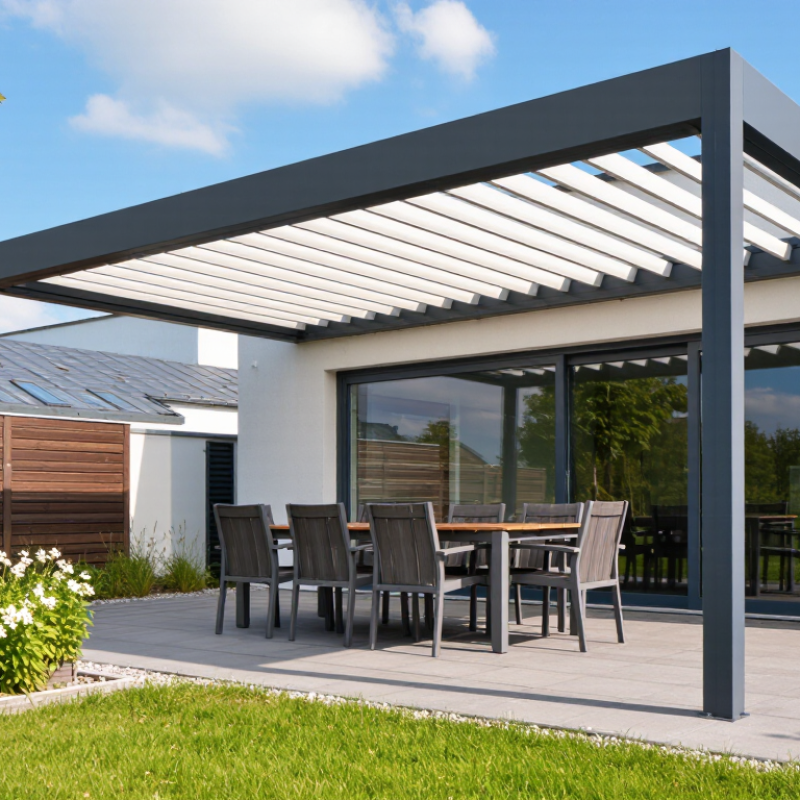
How to Choose the Best Patio Louvered Pergola?

Identify Your Patio Needs and Preferred Pergola Features

Before comparing pergola features, note how your patio is actually used. Measure the seating area, door clearance, and the path from the house. Track direct sun at breakfast and late afternoon. Is rain runoff pooling beside the steps? Wind can also make open slats less comfortable. Small details matter.

The American Society of Landscape Architects’ 2023 Residential Landscape Architecture Trends Survey identifies patios as a prominent residential outdoor feature. Treat that as a cue to plan around daily use, not as proof that every patio needs a pergola.

The U.S. Department of Energy reports that window awnings can reduce solar heat gain by up to 65% on south-facing windows and 77% on west-facing windows. Those figures do not predict pergola performance, but they show why sun direction matters.

For adjustable louvers, check the range of motion, drainage route, and control method. A remote is convenient; a manual crank may be simpler to maintain.

Think about your priorities. Shade for lunch? Rain cover for a table? Louvers cannot block every angle of low evening sun. That may be fine, or it may frustrate you.

Also compare frame materials, wind ratings, and installation requirements against local exposure. Be specific about your needs before choosing features.

Measure the Space and Check Local Installation Requirements

Start by measuring the patio’s usable area, not just the open paving. Note the width and depth, then mark nearby doors, windows, steps, and downspouts. A pergola that fits on paper may still block a sliding door or narrow a walking path. Leave room for louver movement and routine cleaning. Small details matter.

Check the ground, too. Measure from fixed points, such as the house wall, and confirm the surface is level. Record overhead obstacles, including eaves, branches, and utility lines. Then check twice. I used to treat a few inches as harmless; around a post base, they can change the whole layout.

Before choosing a size or anchoring method, contact your local building department and review applicable installation rules. Requirements may cover permits, property-line setbacks, footing depth, drainage, or wind and snow loads. Ask whether the pergola’s location or attached electrical work needs separate approval. Rules vary by area, so don’t rely only on a neighbor’s setup. Keep written guidance and site measurements together. That can prevent costly changes after delivery, although measurements still deserve a second look on installation day.

Compare Louver Materials, Frame Construction, and Durability

When comparing louver materials, consider weather, weight, and upkeep. Powder-coated aluminum is light and resists rust, making it a practical choice in damp or coastal settings. Check the coating for even coverage, especially around cut edges and joints. Aluminum can dent, though, and dark louvers may feel hot under strong sun. Wood offers a warmer look, but it needs regular sealing and careful inspection for swelling or cracks. Small details matter.

Frame construction affects how well the pergola handles everyday use. Look for sturdy posts, reinforced corners, and beams that do not flex noticeably when louvers move. Thicker sections are not automatically stronger; internal supports, joint design, and secure anchors matter too. Stainless or well-protected fasteners can help reduce corrosion where parts meet. Ask how water drains, and inspect the gutters and outlets for easy access. Clogged drainage can cause trouble.

Durability depends on the whole assembly, not one material. A well-built aluminum frame may last longer with less routine care, while wood may suit owners willing to maintain its finish. Moving louvers also add hinges, pivots, and a motor or crank that need periodic checks. I would compare warranty terms with the actual maintenance schedule, rather than relying on broad “all-weather” claims. There is no perfect choice. Your local wind, rain, and sun exposure should guide the final decision.

Evaluate Louver Controls, Weather Protection, and Optional Features

When choosing a louvered pergola, test how the blades move before judging the finish. A hand crank is simple, but it may feel tedious across a wide roof. Motorized controls are easier to adjust; check whether they work during a power cut. A rain sensor can close the louvers automatically, though it does not replace checking seals, gutters, and drainage. Small details matter. Stand beneath the structure and look for water paths, pinch points, and controls you can reach without stretching.

Weather protection depends on more than closing the blades. Ask for documented wind and snow-load limits, and compare them with local design conditions. ASCE 7-22 provides recognized procedures for calculating wind and other structural loads; a generic “all-weather” claim is not a substitute for project-specific ratings. NOAA’s 1991–2020 U.S. Climate Normals can help you assess local precipitation patterns. I would not assume a pergola is suitable for heavy snow unless its documentation says so.

Optional screens, lighting, heaters, and sensors can make a patio more usable, but each adds cost and maintenance. Check wiring protection and whether screens obstruct airflow. For shading context, the U.S. Department of Energy reports that exterior window awnings can reduce summer solar heat gain by up to 65% on south-facing windows and 77% on west-facing windows. Those figures are not pergola performance ratings. Still, they show why shade angle matters. Test the louvers at the hours you use the patio most.

How to Choose the Best Patio Louvered Pergola

Compare louver controls, weather protection, and optional features before choosing a configuration.

How to read this chart: Scores are illustrative checklist ratings from 1 (basic) to 5 (more capable), not measured product-performance data. Actual controls, sensors, drainage, and weather limits vary by model; confirm specifications with the supplier.

Review Installation, Warranty Coverage, and Long-Term Maintenance

When comparing patio louvered pergolas, ask how the installer will anchor the frame to your actual surface. A slab, deck, and masonry wall require different connections. Request a written plan for drainage, electrical routing, and local wind and snow loads. ASCE 7-22 sets out methods for determining those loads; a generic “wind-rated” claim is not enough. Ask who handles permits and inspections, too.

Read the warranty before choosing a finish or motorized system. Check the coverage period for the frame, coating, louvers, and motor separately. Confirm whether labor, water intrusion, and fading are included, and whether maintenance records are required. Small print matters. A long parts warranty may still leave repair labor to you.

Plan simple upkeep: clear leaf litter from the gutters, rinse salt or dust from moving joints, and check fasteners after severe weather. The USDA Forest Products Laboratory’s Wood Handbook links sustained wood moisture above roughly 20% with greater decay risk, a useful reminder to keep nearby timber dry. Zonda’s 2024 Cost vs. Value report estimated an 82.9% resale-value recovery for a wood deck addition; that is a deck benchmark, not a pergola forecast. I’d treat it cautiously. A pergola’s real value depends on site conditions, workmanship, and years of maintenance.

How to Choose the Best Patio Louvered Pergola? - Review Installation, Warranty Coverage, and Long-Term Maintenance
Decision factor Manual louvered system Motorized louvered system What to check before choosing
Louver adjustment Louvers are adjusted by hand using the system’s crank or operating mechanism. No power connection is needed for adjustment. An electric motor adjusts the louvers, often using a switch or remote. Operation depends on the specified power setup and controls. Test the adjustment range and confirm how the louvers are secured in the open, closed, and partly open positions.
Installation planning Check the required tools, number of installers, assembly sequence, and whether the structure must be anchored to a suitable base. In addition to structural assembly and anchoring, plan for the required electrical connection and safe routing of wires. Confirm site measurements, ground or foundation requirements, wall attachment details, access for assembly, and whether local permits or approvals apply.
Rain and drainage When closed, some systems direct water through built-in channels and downspouts; performance depends on the design and correct installation. Drainage considerations are similar to manual systems. Motorization does not by itself guarantee a watertight roof. Ask how water exits the frame, where downspouts can discharge, and what limits apply during heavy rain or wind-driven rain.
Warranty coverage Coverage varies. Review the written terms for the frame, louvers, finish, moving parts, and any exclusions. Review coverage separately for the frame, finish, motor, controls, sensors, and electrical components; these may have different terms. Check the coverage period, start date, claim process, maintenance requirements, labor and shipping exclusions, and whether installation affects eligibility.
Routine maintenance Keep louvers, hinges, tracks, and drainage channels clear of leaves and dirt. Follow the supplied instructions for cleaning and lubrication. Perform the same basic cleaning, and also inspect visible wiring, controls, and motor operation as directed in the product manual. Use cleaning products approved for the materials and finish. Avoid assuming that all coatings or moving parts need the same care.
Long-term checks Periodically inspect anchors, fasteners, alignment, and smooth operation, especially after severe weather. Check structural connections and louver movement; arrange service for electrical or motor issues according to the manufacturer’s instructions. Ask whether replacement parts are available and how the system should be prepared for high winds, snow, or freezing conditions.
Best fit A practical choice when simple operation and avoiding an electrical connection are priorities. A convenient choice when frequent adjustment or powered controls are important and the site can accommodate the electrical requirements. Choose based on site conditions, intended use, installation capability, written warranty terms, and the maintenance you are prepared to perform.

Note: Features, installation requirements, warranty terms, and care instructions differ by product and location. Confirm details in the current installation guide, warranty document, and applicable local requirements before purchase.