
A great roast chicken should taste seasoned beyond its surface, with juicy breast meat and clear, balanced flavor. That is why a Chicken Injector can earn a place beside the thermometer and carving knife. But the best model for 2026 is not simply the one with the most needles or the largest barrel. It should feel steady in the hand, draw thick marinades without clogging, and distribute liquid predictably.
Barbecue educator Meathead Goldwyn is known for an evidence-led approach to cooking. A fitting guidepost, inspired by that approach, is: “Test the tool on real food, not on its marketing.” This is an editorial summary, not a direct quotation. Our comparison considers needle design, capacity, cleaning effort, grip, and how easily each injector handles garlic, herbs, and melted butter. Small details matter. A slippery plunger can leave marinade on the counter; a narrow needle may trap pepper and herb pieces.
There is no perfect injector for every kitchen. A compact syringe may suit occasional Sunday roasts, while frequent cooks may value durable parts and interchangeable needles. We also consider food-safety basics: use clean equipment, keep raw-poultry tools separate, and cook chicken to a safe internal temperature measured with a thermometer. Flavor matters, of course. So does cleanup. One honest caveat: a well-built injector cannot rescue dry chicken or an overly salty mixture. Our picks aim to make good technique easier, not replace it.
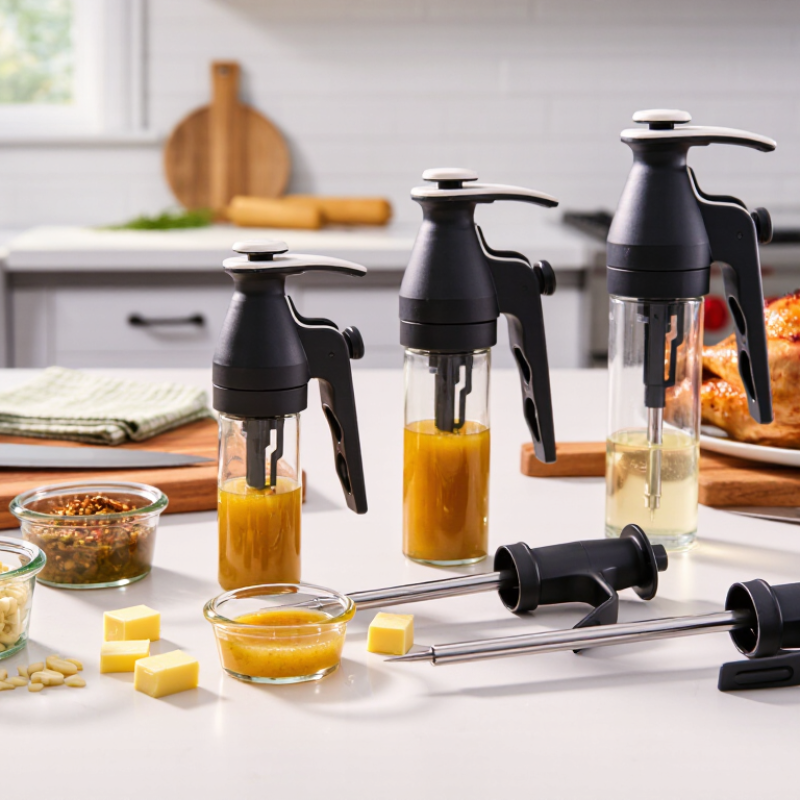
A chicken injector is a hand-operated tool that delivers seasoned liquid beneath the surface of poultry. It usually has a barrel, a plunger, and a hollow needle with small openings. Pulling back the plunger draws in a marinade or brine; pressing it pushes the liquid through the needle and into the meat. That is the basic idea.
The liquid spreads through the muscle, adding flavor and moisture where surface seasoning may not reach. For more even results, inject small amounts into several thick areas, such as the breast and thighs. Press the plunger slowly while withdrawing the needle, so the marinade does not collect in one pocket or squirt back out. A clear barrel helps you see how much liquid remains. Clean every part that touches raw chicken promptly and thoroughly.
For 2026, “best” depends on how often you cook and how much poultry you prepare. A comfortable plunger, a barrel that is easy to fill, and sturdy needles matter more than extra capacity for many home cooks. Thicker marinades can clog narrow openings, so strain out herbs or spices first. More injection is not always better; too much liquid can make the texture unpleasant. It takes a little practice, and even careful cooks may need to adjust their technique.
A chicken injector is a food-grade syringe or pump used to deliver a liquid marinade or seasoning solution inside poultry. The best type depends on how much chicken you prepare, how often you use it, and how easy the injector is to clean.
| Injector Type or Feature | How It Works | Best Suited For | Advantages | Limitations and Selection Notes |
|---|---|---|---|---|
| Single-needle hand injector | A plunger draws liquid into a barrel and pushes it through one hollow needle into the meat. | Occasional home cooking, whole chickens, and individual chicken pieces. | Simple to operate, easy to control by hand, and generally straightforward to take apart for cleaning. | Injection takes time when preparing many portions. Check that the needle opening is suitable for the liquid being used. |
| Multi-hole needle injector | Liquid exits through openings along the needle, helping distribute it at several points as the needle is inserted or withdrawn. | Users who want to spread a thin, well-strained marinade through thicker cuts. | Can distribute liquid along more of the needle’s insertion path than a tip-only opening. | Small openings may clog if herbs, spices, or other solid particles are not strained out. |
| Multi-needle hand injector | Several needles deliver liquid at once, usually as the operator presses a plunger or trigger. | Repeated preparation of multiple portions or larger batches. | Can cover several injection points in one operation and may reduce preparation time. | More parts and needles can make cleaning more involved. Confirm that all food-contact components can be disassembled and cleaned thoroughly. |
| Pump-style injector | A hand-operated or powered pump moves liquid from a reservoir through a hose or injection head. | Frequent batch preparation where a syringe-style tool would be slow. | A reservoir can reduce repeated refilling, and pumping can support a more continuous workflow. | Setup and cleaning may be more involved. Capacity, pressure, and cleaning requirements vary by design, so check the instructions for the specific unit. |
| Needle opening and marinade consistency | The needle carries liquid from the injector into the chicken; the size and placement of its openings affect how easily liquid flows. | Anyone injecting marinades that contain salt, sugar, herbs, or spices. | A needle suited to a smooth, strained liquid is less likely to clog during use. | Strain out solid ingredients before filling the injector. Do not force a blocked needle; disassemble and clean it according to the instructions. |
| Barrel capacity and grip | The barrel holds the liquid, while the plunger or trigger controls how it is delivered. | Choosing a tool that fits the size of the batch and the user’s hand. | A comfortable grip and a visible measurement scale can make filling and dosing easier. | A larger barrel means fewer refills but may be harder to handle when full. Choose a manageable size rather than relying on capacity alone. |
| Food-contact materials and cleaning | Liquid passes through the barrel, seals, and needle, all of which contact food. | Every user, especially anyone who injects poultry regularly. | Removable parts make it easier to clean areas where liquid can remain. | Follow the maker’s cleaning and care instructions. Wash food-contact parts after use and allow them to dry completely before storage. |
| How to Use a Chicken Injector Safely | ||||
| 1. Prepare the marinade | Mix a food-safe liquid marinade and strain out pieces that could block the needle. | Keep raw poultry and its marinade refrigerated until use. Do not reuse marinade that has touched raw chicken unless it is brought to a safe boil. | ||
| 2. Fill and inject | Draw liquid into the injector, insert the needle into several areas, and press the plunger slowly while withdrawing the needle. | Use a clean surface and avoid injecting so much liquid in one spot that it leaks back out. Wash hands and utensils after contact with raw poultry. | ||
| 3. Cook to a safe temperature | Cook the chicken after injection and check its internal temperature with a food thermometer. | Cook poultry to at least 165°F (74°C), checking the thickest part without touching bone. Injection seasons the meat; it does not replace safe cooking. | ||
