
Skip to content

2026 Top Wooden Puzzle Types for Global Buyers

The 2026 Wooden Puzzle market is becoming more specialized, visual, and purpose-driven. Global buyers are no longer choosing only by piece count or low price. They compare material quality, age suitability, packaging, educational value, and retail appeal. The Toy Association and Circana’s recent global toy industry analyses show continued demand for products supporting creativity, family interaction, and screen-free play. These signals make Wooden Puzzle products relevant across gift shops, educational channels, specialty retailers, and online marketplaces.

Market research from Grand View Research identifies jigsaw puzzles as a growing leisure and family entertainment category, supported by digital fatigue and renewed interest in tactile activities. However, wooden puzzles offer more than traditional flat jigsaws. Chunky toddler puzzles, layered educational puzzles, 3D construction sets, geometric brain teasers, map puzzles, animal-shaped puzzles, and customized promotional designs serve different buying needs. Each type creates a different balance between production cost, learning value, durability, and visual presentation. That balance matters.

Global sourcing decisions also require careful verification. Buyers should request material specifications, paint information, sample testing, edge-finishing details, and traceable quality records. FSC-certified wood may support responsible sourcing goals, while relevant toy safety requirements, such as EN 71 or ASTM F963, must be reviewed according to the target market. These standards do not replace professional compliance checks. Small details matter: smooth corners, tight joints, clear age labels, and packaging that survives humid sea freight. No single ranking fits every country. Consumer research remains uneven, and some popular assumptions need testing. This guide compares the top Wooden Puzzle types for 2026 using practical buying criteria, market evidence, and real-world product considerations.
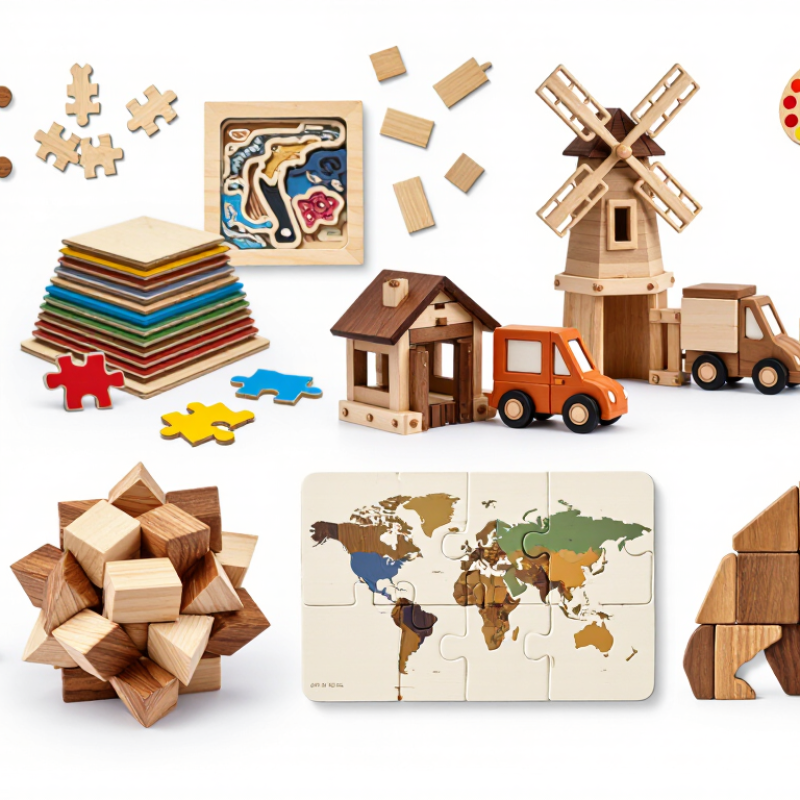
2026 Top Wooden Puzzle Types for Global Buyers

What Are Wooden Puzzles and Why Are They Popular Worldwide?

Wooden puzzles are hands-on games made from cut, shaped, or layered wood pieces. Common types include jigsaw puzzles, tangrams, inset boards, 3D models, and mechanical puzzles. Each type offers a different challenge. Jigsaws develop visual patience, while tangrams encourage spatial thinking. 3D puzzles add structure, balance, and a stronger sense of achievement.

Their worldwide popularity comes from simple materials and screen-free play. A smooth wooden piece feels warmer than plastic. A child may sort pieces by color on a kitchen table, while an adult may study a complex wooden lock after dinner.

Families can share the activity across age groups. Many buyers also value reusable designs, attractive storage, and educational benefits.

However, appearance can be misleading. A beautiful puzzle may have rough edges, weak joints, or unclear instructions. Product comparisons often overlook these practical details.

Tips: Global buyers should check wood moisture control, surface finishing, piece thickness, and odor before ordering. Ask for age grading and safety test documentation when products target children. Confirm packaging strength for long-distance shipping. Small pieces need careful warning labels. Choose puzzles that match the user’s skill level, not only current trends. I think buyers sometimes overvalue difficulty. A frustrating puzzle may remain untouched, which defeats its purpose.

The Main Types of Wooden Puzzles in 2026

2026 Top Wooden Puzzle Types for Global Buyers

The main types of wooden puzzles in 2026 reflect different ages, skills, and retail needs. Wooden jigsaw puzzles remain practical for family use. Their thick pieces resist bending and create a satisfying table experience. Three-dimensional assembly puzzles add stronger visual appeal. They suit gift shops, museums, and educational retailers. Tangram sets support open-ended play, while wooden logic puzzles encourage patience and spatial reasoning. Peg puzzles and shape boards remain useful for early learning, especially with large, easy-grip pieces.

Industry data supports continued interest in play products with learning value. Circana reported a 7% decline in global toy sales during 2023, increasing pressure on buyers to choose durable products. Grand View Research has also identified educational value as a major driver in the wooden toy market. These reports do not guarantee puzzle sales. Forecasts can miss cultural differences, shipping costs, and changing family budgets. A puzzle may look premium but still warp in humid storage. That detail deserves more attention.

Tips: Compare wood thickness, finish, piece fit, packaging strength, and age guidance before ordering. Request samples from different production batches. Check applicable safety requirements, such as EN 71 or ASTM F963, for the destination market. Avoid oversized assortments without testing demand. Small logic puzzles may sell well in travel channels, while larger jigsaws need more shelf space. Product photos can also mislead buyers about actual dimensions. Measure the assembled puzzle, not only the box.

2026 Top Wooden Puzzle Types for Global Buyers - The Main Types of Wooden Puzzles in 2026

No. Wooden Puzzle Type Typical Format Common Piece or Part Range Primary Skill Developed Typical User Group Common Buyer Application Key Sourcing Considerations Recommended Age Guidance
01 Wooden Jigsaw Puzzles Flat interlocking pieces forming an image, map, or educational scene 12–1,000+ pieces Visual recognition, concentration, spatial reasoning, and patience Children, families, adults, and seniors Educational retail, gifts, family leisure, museums, and tourism products Piece fit, image printing quality, board thickness, smooth edges, and storage packaging Usually 3+; complexity should match the child’s age and ability
02 3D Wooden Construction Puzzles Interlocking or slot-together parts assembled into animals, vehicles, buildings, or structures 10–300+ parts Three-dimensional thinking, sequencing, fine-motor control, and problem solving Children, teenagers, hobbyists, and families STEM learning, craft stores, educational programs, and hobby collections Cutting precision, assembly instructions, structural stability, part identification, and splinter-free finishing Commonly 5+; small parts may require an older age rating
03 Wooden Montessori-Style Puzzles Simple boards featuring knobs, shape matching, color matching, or basic sequencing 1 board with 3–20 removable pieces Shape recognition, hand-eye coordination, sorting, and early cognitive development Infants, toddlers, preschool children, and caregivers Early-learning centers, daycare, home learning, and children’s gift retail Large easy-grip pieces, non-toxic coatings, rounded edges, secure knobs, and clear age labeling Often 12 months–5 years, depending on design and part size
04 Wooden Tangram Puzzles Seven-piece geometric sets used to create silhouettes, animals, and abstract patterns Usually 7 pieces per set Geometry, symmetry, spatial visualization, and creative problem solving Children, students, teachers, families, and puzzle enthusiasts Classroom activities, educational kits, travel games, and logic-puzzle collections Accurate geometric cutting, contrasting colors, smooth surfaces, pattern cards, and compact packaging Generally 5+; advanced pattern challenges suit older users
05 Wooden Brain Teaser Puzzles Interlocking, disentanglement, or sequential puzzles requiring a specific solution 2–20+ components Logical reasoning, strategic planning, patience, and spatial analysis Teenagers, adults, puzzle clubs, and corporate gift buyers Gift shops, educational enrichment, office gifts, and entertainment retail Solution difficulty, durable joints, repeat-play value, instruction quality, and compact presentation Usually 8+; some difficult designs are intended for adults
06 Wooden Burr Puzzles Three-dimensional assemblies made from interlocking notched wooden sticks or blocks Typically 6–12 main pieces Spatial reasoning, sequencing, dexterity, and mechanical thinking Teenagers, adults, collectors, and experienced puzzle users Specialty gifts, hobby stores, desk accessories, and educational demonstrations Notch accuracy, wood stability, smooth sliding surfaces, assembly tolerances, and solution documentation Commonly 12+ because of complexity and smaller components
07 Wooden Stacking and Balance Puzzles Blocks, discs, or shaped pieces stacked according to balance or pattern rules 10–60 pieces Balance, hand control, planning, and cause-and-effect learning Young children, families, classrooms, and casual players Preschool learning, family games, indoor activities, and promotional gifts Stable geometry, tactile finish, rounded corners, color consistency, and safe piece dimensions Usually 3+; very small pieces are unsuitable for children under 3
08 Wooden Sliding Block Puzzles Pieces move within a framed tray to reach a target arrangement or exit position 5–20 movable pieces Planning, sequencing, spatial reasoning, and working memory Children, teenagers, adults, and puzzle hobbyists Logic-game ranges, travel products, educational toys, and family entertainment Track smoothness, frame strength, piece tolerances, challenge levels, and portability Generally 6+; age suitability depends on the puzzle’s challenge level
09 Wooden Number and Letter Puzzles Alphabet, number, spelling, counting, or word-building boards and loose-piece sets 10–36 pieces or tiles Early literacy, numeracy, vocabulary, recognition, and fine-motor skills Preschool children, early learners, parents, and educators Schools, daycare centers, home education, and learning-toy retail Readable characters, color contrast, durable printing, easy-grip pieces, and non-toxic finishes Commonly 2–6 years, depending on the learning objective
10 Wooden Mechanical and Lock Puzzles Boxes, locks, secret compartments, or mechanisms opened through a sequence of actions 1 case with multiple moving or locking elements Logical deduction, mechanical understanding, memory, and persistence Adults, teenagers, collectors, and gift buyers Premium gifts, escape-room activities, desk products, and specialty puzzle retail Mechanism reliability, joint durability, precise tolerances, repeat usability, and clear solution support Typically 12+; some advanced models are designed for adults

Buyer note: Age guidance varies by design, piece size, complexity, and applicable market regulations. Purchasers should verify local toy-safety, labeling, and chemical-compliance requirements before commercialization.

How Wooden Puzzles Differ by Design, Difficulty, and Age Group

2026 Top Wooden Puzzle Types for Global Buyers

Wooden puzzles now serve different purposes, from quiet home play to educational retail collections. Their design strongly affects how buyers use them. Flat jigsaw puzzles suit families and older children, while chunky knob puzzles help toddlers practice grip and matching. Layered puzzles add depth, but they may frustrate beginners when pieces appear visually similar.

Difficulty depends on piece count, shape, thickness, and image detail. Large, irregular pieces usually create an easier starting point. Small pieces and repeated patterns require stronger concentration. I have found that a simple animal puzzle can challenge children more than a crowded landscape. That surprised me. Difficulty is not measured by piece numbers alone.

Age guidance should consider motor skills, attention span, and safe handling. Toddlers need oversized pieces without sharp edges or detachable tiny parts. Children aged five to eight often enjoy story scenes, maps, and basic mechanical puzzles. Older children and adults may prefer interlocking silhouettes, three-dimensional models, or logic-based designs. Buyers should check wood quality, finish, packaging, and applicable safety requirements in the destination market. Water-based coatings can be a useful choice, but sellers should confirm the manufacturer’s test documentation. A decorative puzzle may look premium, yet poor fitting pieces quickly reduce customer trust. Seasonal demand also matters, although predicting it perfectly is unrealistic.

Key Factors Global Buyers Should Consider Before Purchasing

2026 Top Wooden Puzzle Types for Global Buyers

Global buyers should evaluate wooden puzzles beyond shape, age range, and visual appeal. Material traceability matters. FSC’s 2024 facts report covers more than 160 million hectares of certified forest worldwide, giving buyers a practical benchmark for responsible wood sourcing. Ask for chain-of-custody evidence, wood species, moisture control, and paint safety documents. A smooth, splinter-free piece is essential, especially for children’s products. Testing should align with relevant requirements, such as EN 71, ASTM F963, or ISO 8124. Standards differ by destination.

Packaging and logistics can quietly reshape total cost. UNCTAD’s Review of Maritime Transport 2024 states that over 80% of global merchandise trade moves by sea. That makes carton strength, humidity protection, and accurate shipping dimensions important. The World Bank’s 2023 Logistics Performance Index gathered evidence from 4,090 logistics professionals across 139 economies, showing how customs and delivery reliability vary between markets. Buyers should request drop-test results, packaging photos, and a realistic lead-time range. Not only the best-case estimate.

Design validation also deserves attention. A puzzle may look attractive in a catalogue but feel frustrating on a real table. Check piece fit, edge thickness, color consistency, and assembly time with sample users. Small batches reduce risk, although they usually increase unit cost. That trade-off is easy to underestimate. Product records, inspection reports, and clear corrective-action procedures help convert supplier claims into dependable purchasing evidence.

2026 Top Wooden Puzzle Types for Global Buyers

Typical piece counts by wooden puzzle type can help buyers compare product complexity, packaging needs, target age groups, and expected assembly time before purchasing.

The figures represent common retail configurations: tangram and burr puzzles usually contain fewer loose pieces, while wooden jigsaw and 3D construction puzzles generally require more components. Exact piece counts vary by design and supplier.

2026 Trends in Wooden Puzzle Materials, Safety, and Customization

2026 Top Wooden Puzzle Types for Global Buyers

In 2026, wooden puzzles are moving toward safer materials and clearer sourcing. FSC reported over 160 million hectares of certified forests worldwide in 2024. This figure supports demand for traceable wood, but certification alone does not prove product safety. Buyers should request material records, paint specifications, and batch testing. Water-based coatings are popular, yet “water-based” is not automatically non-toxic.

Safety testing remains a purchasing priority. The U.S. Consumer Product Safety Commission recorded about 231,500 toy-related emergency-department injuries among children under 15 in 2023. For wooden puzzles, smooth edges, secure knobs, and suitable piece sizes matter. International buyers should check relevant requirements, including EN 71 or ISO 8124, depending on the destination market. Small parts still create avoidable risks. Some suppliers overlook them.

Tips: Ask for recent test reports, not only certificates. Confirm the report matches the exact wood, coating, and puzzle design. For customization, consider engraved names, regional learning themes, and modular shapes. Digital previews reduce mistakes, but physical samples reveal rough edges and color differences. I have found that beautiful prototypes can still feel too heavy for young children. This detail deserves more attention.

Article Source: