
A well-chosen Antique Dressing Table can bring useful storage and quiet character to a bedroom. Yet photographs rarely reveal a loose joint, a cloudy mirror, or a drawer that catches halfway. Global buyers also face different shipping distances, inspection options, and restoration expectations. The details matter. Grand View Research estimated the global furniture market at USD 541.52 billion in 2023, with projected growth through 2030. That broad figure is useful context, not a measure of the antique dressing-table market. Buyers should judge each piece on its own condition, materials, craftsmanship, and documented history.
Design authority William Morris wrote, “Have nothing in your houses that you do not know to be useful, or believe to be beautiful.” His principle suits a dressing table: a practical drawer layout and a mirror you enjoy looking into both count. This guide helps global buyers assess period styles, wood and veneer, mirror condition, repairs, provenance, and delivery questions before committing. A close-up of a joint or the back of a drawer can tell more than a polished listing image. Some wear is honest age; some damage deserves a repair estimate. It is not always easy to tell the difference remotely. Even experienced buyers can miss details, so a careful checklist is not a guarantee. It is a better starting point.
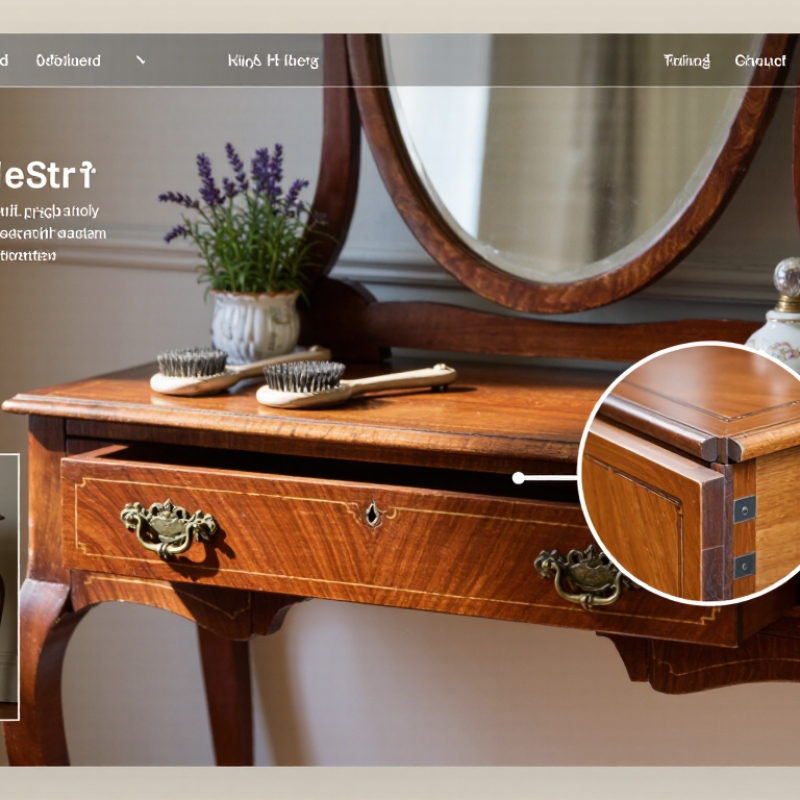
Antique dressing tables combine storage, grooming space, and decorative design. Common forms include compact tables with one mirror, larger three-panel models, and vanity desks with drawers. Some have a lift-top compartment for small personal items. Their layout can reveal how people used the furniture, but later repairs may change original details.
Period and style offer useful clues. Georgian examples often favor balanced proportions and restrained ornament. Victorian tables may show turned legs, carved details, and larger mirrors. Art Nouveau pieces can feature flowing lines and floral motifs. These categories overlap, and a table’s appearance alone cannot confirm its age. Not always. Check construction, hardware, finish, and documented ownership where available. A replaced mirror or modern screw may tell part of the story, not the whole one.
Tips: Inspect drawer joints and the underside for consistent aging. Look for wear where hands naturally touched the handles, and note any sharp differences in color or finish. Ask for clear photos of the back, legs, and interior. Patina can be attractive, but it is not proof of age. Measurements matter too: a wide mirror may need more room than the table itself suggests. Details matter.
Compare common dressing-table forms and period styles, then use the inspection points to guide research and an in-person assessment. Dates are approximate: furniture styles overlapped across regions, and later pieces were often made in earlier styles.
| Type or Style | Typical Period | Recognisable Features | Common Materials and Construction | What to Check Before Buying |
|---|---|---|---|---|
| Georgian dressing table | 1714–1830 | Often a compact, practical table with drawers; forms and ornament vary widely through the period. Earlier examples may have cabriole legs, while later designs can be more restrained. | Commonly mahogany, walnut, or oak; solid timber, veneer, and dovetailed drawer construction may be found. | Inspect drawer joints, underside, back, and leg attachments. Look for repairs, replacement handles, veneer patches, and signs that the finish or hardware has been altered. |
| Lowboy | Especially popular in the 18th century | A low dressing or serving table, usually with drawers and cabriole legs. The term describes a furniture form rather than a single fixed design. | Often made from walnut or mahogany, with shaped aprons, turned or carved legs, and brass drawer pulls. | Check whether the top, legs, apron, and drawers appear consistent in age and construction. A lowboy may have been used as a dressing table, but not every example was made for that purpose. |
| Kneehole dressing table | 18th century onward | A central recessed space beneath the top, flanked by drawers or cupboards. Some examples have a central drawer or a small cupboard between the side pedestals. | Mahogany and other hardwoods are common; construction may combine solid wood and veneer. | Check the stability of the pedestals and central section. Examine the knee space for modifications, replaced panels, or evidence that the piece was adapted from a desk. |
| Bonheur du jour | Late 18th century, particularly associated with France | A small writing or occasional table with a raised superstructure, often fitted with small drawers or compartments. Some examples could serve as a dressing or personal table. | May feature mahogany or other veneers, delicate supports, small drawers, and decorative inlays or mounts. | Because the form has delicate upper sections, check for cracks, loose joints, replaced feet, and missing or later-added fittings. Confirm the seller’s description of its original function. |
| Regency-style dressing table | Approximately 1811–1820 in Britain; Regency design continued beyond this period | Often uses balanced proportions, clean lines, and classical or Egyptian-inspired details. A swing mirror may be fitted to a separate frame on some dressing furniture. | Mahogany is common in British examples; brass mounts and turned or reeded details may be present. | Check mirror supports and pivots, if fitted, as well as the stability of the frame. Distinguish an original mirror from a later replacement and ask whether fittings have been restored. |
| Victorian dressing table | 1837–1901 | Designs range from heavily ornamented revival styles to simpler forms. Larger examples may include a mirror and multiple drawers or a matching washstand arrangement. | Mahogany, walnut, oak, and rosewood veneers appear in period furniture; marble or other stone tops occur on some pieces. | Inspect mirror glass and frame, stone tops, drawer runners, and veneer edges. Look for water damage, replaced mirrors, structural movement, and repairs concealed by polish. |
| Arts and Crafts dressing table | Late 19th to early 20th century | Typically emphasises visible workmanship, straightforward forms, and restrained decoration. Exact details differ among makers and regional traditions. | Oak is frequently used; construction and finish are often intended to show the character of the wood. | Examine joints, surface wear, and any applied metalwork or inlay. A simple appearance alone does not establish age; compare construction details with reliable reference examples. |
| Art Nouveau dressing table | Approximately 1890–1910 | May feature flowing lines, asymmetry, and nature-inspired carving or decoration. The style varies by country and workshop. | Wood, veneer, glass, and decorative metal fittings may be used; materials vary substantially between examples. | Check curved or carved sections for breaks and restoration. Verify whether decorative panels and fittings are original to the piece rather than later additions. |
| Edwardian dressing table | Approximately 1901–1910; the broader Edwardian era is sometimes dated to 1914 | Many examples have lighter proportions and less dense ornament than some Victorian furniture, though revival designs also remained popular. | Mahogany, satinwood, oak, and veneers are among the materials used; some pieces have a framed mirror. | Check the mirror frame, drawer action, and finish for replacements or later restoration. Treat style as a clue, not proof of a precise manufacturing date. |
| Art Deco dressing table | Primarily 1920s–1930s | Often features geometric forms, stepped profiles, symmetry, and contrasting surfaces. Designs range from restrained to highly decorative. | Veneered hardwoods and polished finishes are common; glass, metal, or other contrasting materials may appear. | Inspect veneer for lifting, bubbling, or losses, especially around edges and curved surfaces. Check mirror attachment and ask whether any replacement glass or refinishing has been carried out. |
Buyer’s note: In furniture, “antique” is often used for items more than 100 years old, but legal definitions and import rules vary by country. Request clear photographs of the underside, back, joints, drawers, and any damage; obtain measurements and condition details in writing; and budget for safe packing, shipping, taxes, and professional restoration where needed. A style resemblance is not, by itself, authentication or proof of age.
